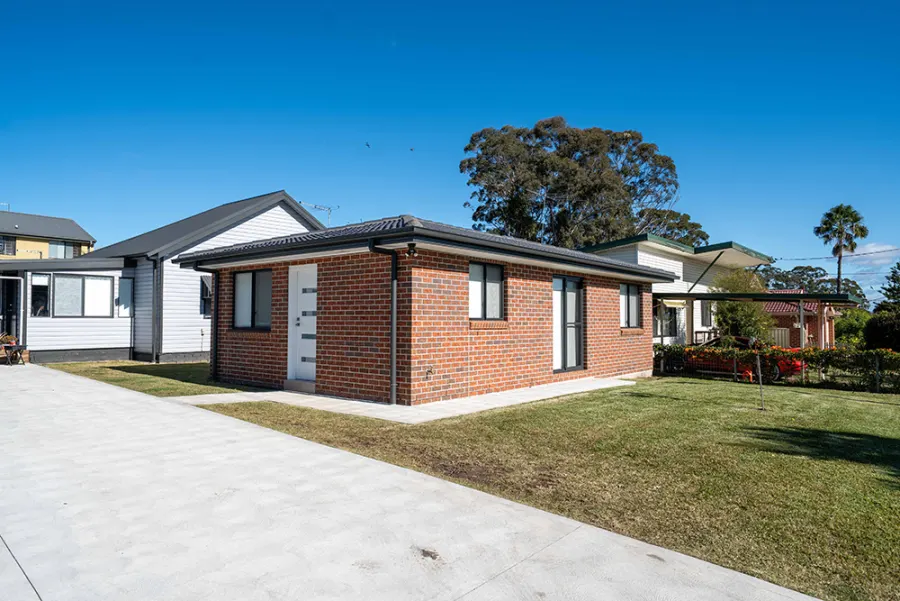
Yes — for most Sydney homeowners with a block of 450m² or above, a granny flat is one of the strongest passive income moves available in 2026. Gross rental yields in Western Sydney are running at 8 to 12%, rents sit between $400 and $650 per week depending on size and suburb, and the build timeline is 14 to 16 weeks once approved. Here’s what the full picture looks like.
Sydney’s rental market has been under serious pressure since 2022, and 2026 hasn’t given tenants any relief. Vacancy rates across Greater Sydney sit at approximately 1.6% — historically tight — and median weekly house rents have crossed $780 (CoreLogic, December 2025). For homeowners who own a qualifying block, that environment represents a clear financial opportunity: put your underutilised backyard to work generating weekly rental income without selling part of your property or taking on a complex development project.
The granny flat is arguably the most accessible secondary income play in the Australian property market right now. The build costs are clearly scoped, the approval pathway (via CDC) is fast and predictable, and the rental return comes from day one of tenancy. This guide walks through everything you need to know — returns, costs, tax implications, design choices, and how to select a builder who delivers it all without leaving you to manage the process yourself.
1. What Rental Returns Can I Actually Expect?
Rental income for a granny flat in Sydney varies based on three things: location, size, and finish quality. Across Greater Sydney in 2026, the realistic weekly range runs from approximately $400 for a compact studio or 1-bedroom in an outer suburb up to $650+ for a premium 2-bedroom in a well-connected inner or middle ring suburb.
On an annualised basis:
- A 1-bedroom renting at $450/week generates approximately $23,400 per year in gross income
- A 2-bedroom renting at $570/week generates approximately $29,640 per year in gross income
These are gross figures. After property management fees (typically 7–10% of rent), landlord insurance, and routine maintenance, net returns are lower. The net yield calculation is what matters for financial planning, and it’s worth running those numbers with your accountant before committing to a build.
Rental figures in this guide are sourced from aggregated 2026 listing data across Sydney LGAs. Your actual achievable rent depends on your specific suburb, block layout, finish quality, and whether the granny flat has a private entrance and separate utilities. A local property manager can give you a realistic rental appraisal for your specific address before you build.
2. Rental Rates by Suburb Type
Location has the single biggest impact on achievable rent. Here’s how Greater Sydney breaks down into broad rental bands for 2-bedroom granny flats in 2026:
| Area | Example Suburbs | Typical 2-Bed Weekly Rent | Key Driver |
|---|---|---|---|
| Inner West / North Shore | Marrickville, Leichhardt, Mosman, Lane Cove | $580–$650+ | Proximity to CBD, lifestyle demand |
| Middle Ring (North / West) | Parramatta, Hills District, Epping, Ryde | $520–$600 | Employment hubs, schools, transport |
| South-Western Sydney | Liverpool, Campbelltown, Fairfield, Bankstown | $450–$540 | High rental demand, lower vacancy |
| Western Sydney | Blacktown, Penrith, Merrylands, Auburn | $420–$520 | Strong yields relative to build cost |
| Outer South-West | Narellan, Camden, Oran Park | $400–$490 | Growth corridor, family demand |
Western Sydney consistently delivers the strongest gross yields relative to build cost — even though absolute rents are lower than inner-city areas, the lower construction cost in many Western Sydney LGAs means your return on investment is often superior. Net yields of 8 to 12% in areas like Cumberland, Canterbury-Bankstown, and Liverpool LGAs are well-documented in 2026 property research.
Want to know what your block can earn?
Book a free site assessment. We’ll confirm your CDC eligibility and give you a realistic rental return estimate based on your suburb and design options.
3. Cost vs Return: The Payback Calculation
Five Star’s granny flat designs start from $170,000 for a 1-bedroom model (Foxwood or The One, 47–49m²) and run through to $245,000+ for premium 2-bedroom designs (The Phoenician, The Ultimate, 60m²). Here’s how the payback calculation looks across two representative scenarios:
The payback figures above are illustrative examples using indicative pricing and mid-range rental assumptions. Your actual build cost depends on your specific site conditions (slope, soil, access, slab requirements). Your actual rental return depends on your suburb and the finish level you choose. These are not financial projections — consult a financial adviser or accountant for a plan specific to your situation.
The key insight here is that even at the payback period level, a granny flat compares favourably to almost any other capital improvement you can make to an existing residential property. A kitchen renovation might cost $50,000–$80,000 and generate zero weekly income. A granny flat starts generating income from day one of tenancy.
4. Property Value Uplift
Beyond weekly rental income, a granny flat adds measurable value to your property at resale. Research published in API Magazine (2026) found that adding a granny flat increases a property’s overall rental yield by 1.4 to 1.65 percentage points compared to similar properties without one. That yield uplift directly translates to a higher appraised value for investors who buy on yield.
The other factor is the dual-income buyer pool. A property with a tenanted granny flat appeals to a specific type of buyer: investors who want an income stream from day one, and owner-occupiers who want the rental income to offset their mortgage. That’s a materially different (and in many markets, larger) buyer pool than a single-dwelling property.
One site — Sydney Estate’s 2026 granny flat guide — puts the value add at up to 30% on rental yield when compared to the property without the dwelling, citing CoreLogic data. The absolute dollar uplift in sale price varies too much by suburb to state reliably, and we recommend speaking with a local property valuer for a site-specific estimate.
A granny flat does two things at once: it generates weekly rental income while you own the property, and it adds to the property’s value when you eventually sell. Most capital improvements do one or the other. A well-built secondary dwelling does both.
5. Tax Benefits and Depreciation
Renting out a granny flat comes with a range of tax benefits that meaningfully improve your net return. The ATO’s guidance on residential rental properties outlines the main deductions available to landlords, which for a granny flat owner typically include:
- $Depreciation on the building and fixtures — a quantity surveyor prepares a depreciation schedule; first-year deductions on a new $195k build can run to $5,000–$9,000, materially reducing taxable income
- $Interest on any loan used to fund the build — if you borrowed against equity or took a construction loan, interest is deductible against rental income
- $Property management fees — the cost of a property manager (7–10% of rent) is fully deductible
- $Insurance premiums — landlord insurance, building insurance apportioned to the granny flat
- $Maintenance and repairs — routine repairs, pest control, landscaping of the granny flat’s area
- $Apportioned council rates — the portion of council rates attributable to the rented part of the property
Renting out part of your main residence affects your capital gains tax (CGT) main residence exemption when you eventually sell. The portion of your property used to generate income (the granny flat) may be subject to CGT on sale. The ATO has specific rules on this and the interaction is complex — the structure you choose (renting to family vs market tenants, separate utilities or shared) can affect your exposure. We strongly recommend consulting a registered tax adviser before you build if you plan to rent out the granny flat. Getting this right from the start is significantly easier than restructuring later.
If you plan to rent to family members rather than market tenants, note that the ATO requires rent to be at or near market rates for deductions to apply in full. Below-market rent to a family member limits your ability to claim the property’s expenses against your income. See the ATO’s guidance on rental income declarations for the applicable rules.
Ready to run the numbers on your block?
Our free site assessment covers CDC eligibility, design fit, and build cost — so you can take real numbers to your financial adviser.
6. What to Look for in an Investment Granny Flat
Not every granny flat design generates the same rental return. If you’re building specifically to maximise income, these factors make a material difference to your weekly rent and tenant quality:
- Separate entry: This is non-negotiable for investment. Tenants will not pay a premium rent for a front door shared with the main dwelling. A fully private entrance — not accessed through the landlord’s yard — is what distinguishes a rentable secondary dwelling from a converted garage.
- Separate utility metering: Separate electricity metering removes the most common source of landlord-tenant friction and makes the property more appealing to self-sufficient tenants. If separate metering isn’t possible on your site, clearly defined utility arrangements must be documented in the lease.
- 2 bedrooms over 1: A 2-bedroom granny flat reaches a much wider tenant pool — couples, small families, two friends sharing — and achieves $100–$150/week more than an equivalent 1-bedroom in most Sydney suburbs. The build cost difference rarely exceeds $30,000–$40,000, making the 2-bed a stronger investment in most cases.
- Modern kitchen and bathroom: Sydney tenants paying $500+/week expect contemporary finishes. Dated fit-outs lead to lower rents, longer vacancies, and higher-maintenance tenants. Five Star’s standard inclusions are designed to the finish level the Sydney rental market expects at this price point.
- Private outdoor area: Even a small courtyard or patio makes the difference between a granny flat that feels like a home and one that feels like a shed conversion. Properties with some private outdoor space consistently rent faster and hold tenants longer.
- Natural light: North-facing orientation where possible. A granny flat that gets good natural light feels larger and more comfortable, which matters when you’re fitting a full home into 47–60m².
7. Five Star’s Top Investment Designs
Five Star’s full range of granny flat designs is built to meet CDC approval criteria from day one. Here are the designs our investment-focused clients consistently gravitate toward, and why:
The Crown and Deluxe represent the strongest investment value in most Western and South-Western Sydney suburbs — the build cost is lower than the premium 2-bed range while still achieving competitive 2-bedroom rents. The Madison and Phoenician suit inner-ring and North Shore markets where tenants expect a higher finish level and will pay accordingly. Browse the full floor plans gallery to see every design and its layout.
8. How Five Star Takes Care of Everything
One of the biggest concerns we hear from first-time granny flat investors is: “How much of this do I have to manage myself?” The answer, for Five Star clients, is very little. Here’s how the end-to-end process works:
Free Site Assessment
We visit your property, check your block against CDC eligibility criteria, assess site conditions (slope, soil, access), and give you a clear indication of which designs fit your site and what the build will cost. No obligation. This is the step that turns a vague idea into a real project.
Design Selection
You choose from our award-winning range of designs — or work with our team on a custom variation if your site calls for something specific. Every design is built to CDC compliance from the outset.
Approval — We Handle It
For CDC builds (the majority of our projects), Five Star prepares and submits the complete application package to our network of trusted private certifiers. You don’t source a certifier or manage submissions. CDC approval typically takes 3 to 6 weeks — see our approval guide for the full breakdown.
Construction — 14 to 16 Weeks
Once approval is granted, our construction team takes over. Our builds are completed in 14 to 16 weeks from construction start. You’re kept informed throughout with regular updates — but there’s no project management burden on you.
Handover and Tenancy
At handover, your granny flat is complete, compliant, and ready to lease. We can refer you to our preferred property management partners in your area if you need help finding and managing tenants. From that point, your investment is generating income.
Five Star has completed 200+ Sydney builds, holds a 4.9 Google rating, and carries a 6-year structural warranty on every project. Read what our clients say on our reviews page. The investment case for a granny flat is only as strong as the builder delivering it — that’s the part that matters most.
9. Frequently Asked Questions
In 2026, granny flat rents across Greater Sydney range from approximately $400 to $650 per week depending on suburb, size, and finish quality. Studios and compact 1-bedroom flats in outer suburbs typically sit at the lower end of that range ($350–$450). Well-finished 2-bedroom granny flats with a private entrance in middle-ring or inner suburbs can achieve $550 to $650 per week. Western Sydney LGAs like Cumberland, Canterbury-Bankstown, and Liverpool offer strong gross yields relative to build cost — often 8 to 12% — even though the absolute weekly rents are below inner-city levels.
The single biggest variable is location. A local property manager can give you a rental appraisal for your specific address before you commit to a build.
Yes — a well-built granny flat adds value to your property through two mechanisms: it increases the property’s rental yield (by 1.4 to 1.65 percentage points according to 2026 API Magazine research drawing on InvestorKit data), and it expands your buyer pool at resale to include investors who want an income-producing property. The exact dollar uplift varies considerably by suburb and market conditions. For a site-specific estimate of value uplift, we recommend speaking with a local property valuer or buyer’s agent who actively works in your area.
Five Star Granny Flats completes most Sydney builds in 14 to 16 weeks from the start of construction. This timeline begins after approval is granted — the approval process itself (via the CDC pathway) typically takes 3 to 6 weeks from when the complete application is submitted to the private certifier. From your first contact with Five Star to a tenanted granny flat, most clients are looking at approximately 5 to 6 months in total, depending on how quickly the approval process moves and when construction can begin on your site.
Short-term rental via Airbnb and similar platforms is permitted in NSW under state-level rules, but local councils apply their own restrictions in some areas. For most granny flats in standard residential zones across Greater Sydney, short-term rental is allowed. However, you must register the property with the NSW Short-Term Rental Accommodation register, comply with the mandatory Host Code of Conduct, and check your specific council’s local provisions — some councils cap non-hosted short-term rental to 180 days per year. See the NSW Planning Portal’s short-term rental guidance for the current rules. We recommend verifying with your local council before listing.
Yes — rental income from a granny flat is assessable income and must be declared on your annual tax return. However, you can offset that income against legitimate deductions: depreciation on the building and fixtures, interest on any loan used to fund the build, property management fees, insurance, and repairs. The net effect depends on your income level and the quantum of deductions — many investors in higher tax brackets find the depreciation benefit alone significantly reduces their net tax liability in the first few years. The key complexity to be aware of is the interaction with your main residence CGT exemption at sale — get specific advice from a registered tax adviser before you build. See the ATO’s rental properties guide for a comprehensive overview.
In most Sydney markets, a 2-bedroom granny flat delivers a stronger investment return than a 1-bedroom, despite the higher build cost. Here’s why: the weekly rent premium for a 2-bed over a 1-bed is typically $100 to $150 per week, which adds up to $5,200 to $7,800 per year in additional gross income. The additional build cost for a 2-bed over a 1-bed is usually in the range of $25,000 to $50,000. That means the payback on the extra investment is often just 4 to 7 years — and after that, the income advantage compounds. A 2-bed also attracts a larger tenant pool (couples, small families, sharers) which reduces vacancy risk. The main case for a 1-bedroom is a smaller block where a 2-bed design won’t physically fit, or a tighter budget where the 1-bed entry price is what makes the project feasible.